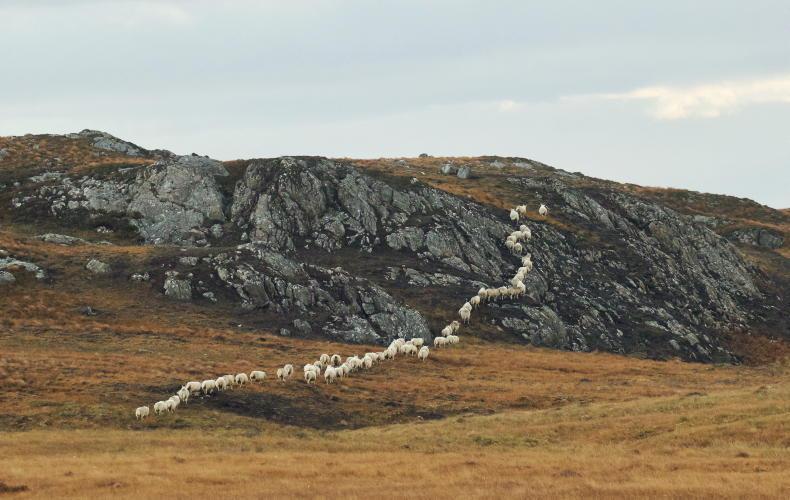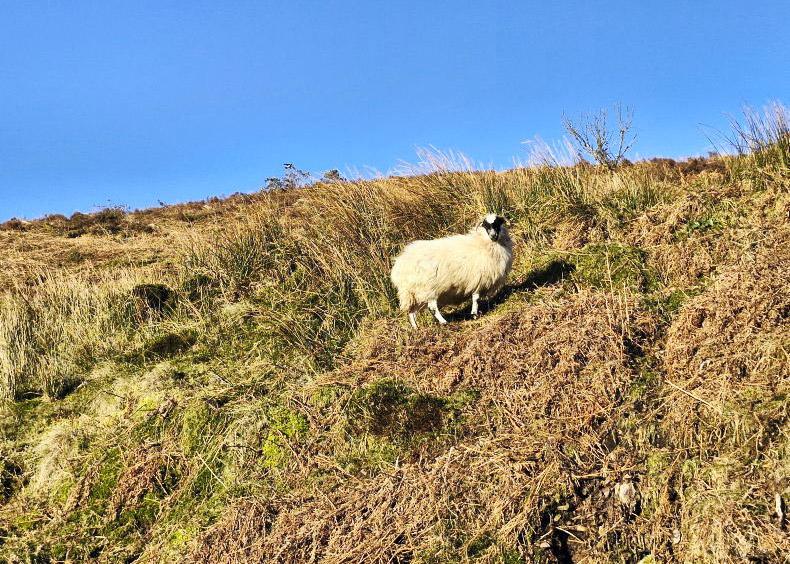

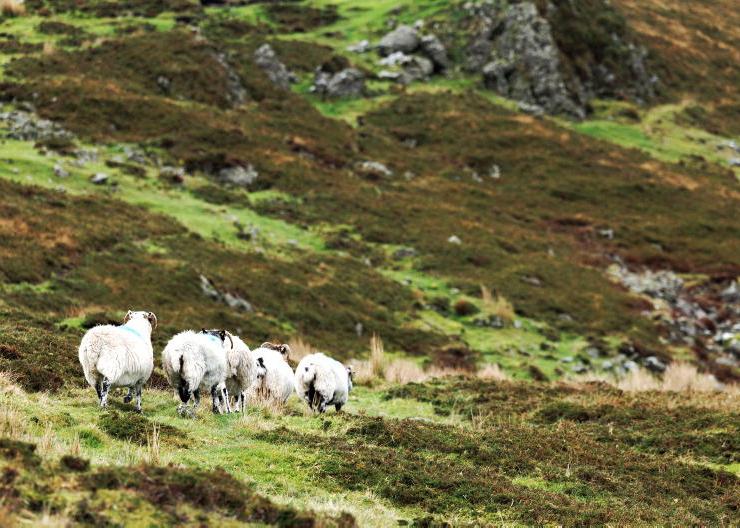
Keeping farming in uplands areas is going to be one of the main battles facing sheep producers farming in uplands areas in the future.
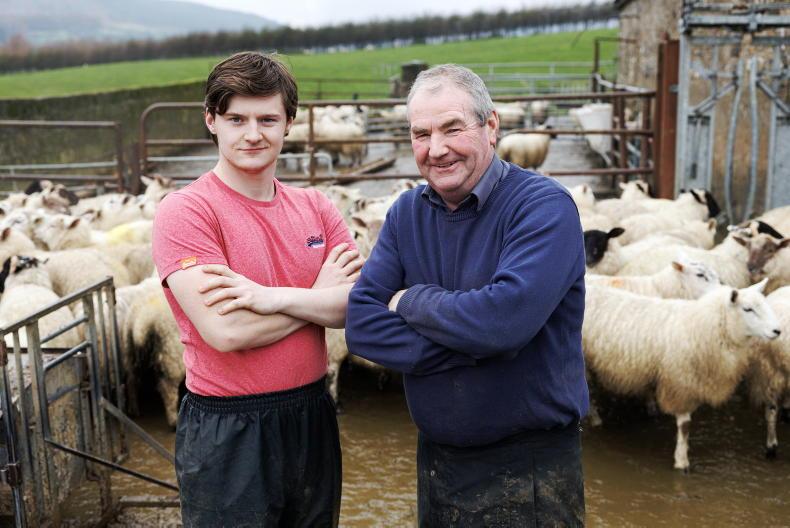
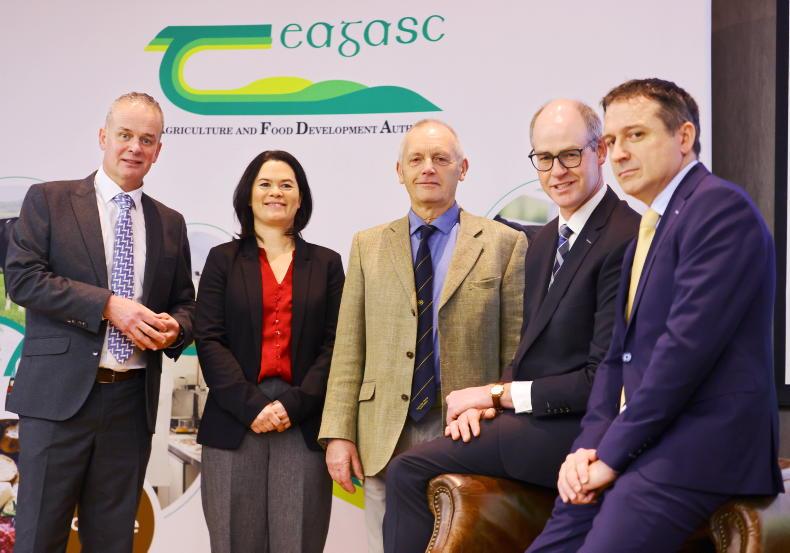
This sobering statement set the scene for an excellent presentation delivered by Phil Stocker MBE, chief executive of the UK National Sheep Association (NSA) at last week’s Uplands Symposium organised by Teagasc and CAFRE.
Stocker told delegates attending that he sees so many challenges for upland hill farming in the UK and that keeping hill farming alive and thriving is going to be one of the greatest challenges facing the sector.
“These are hugely multifunctional areas, they’ve been recognised through a number of designations, whether it’s triple SI status (site of special scientific interest) or Special Areas of Conservation or national parks they are recognised because of their beauty, in terms of storing water, storing carbon and providing health and wellbeing through access and all those sorts of things,” he said.
Past failings
He acknowledged that the manner in which upland areas were managed in the past was not appropriate but was a feature of government policy and an aim to drive increased food production.
“If you look at them they are largely created through centuries of farming and human activity and I would be the first in my role as the CEO of the NSA to hold my hands up and say we went a little bit wrong in the 1980s and ’90s when the headage payments drove stock numbers - sheep numbers – up and up and up and I don’t think that did farming any good, I don’t think it did food production from farming a great deal of good either or our reputation with society.”
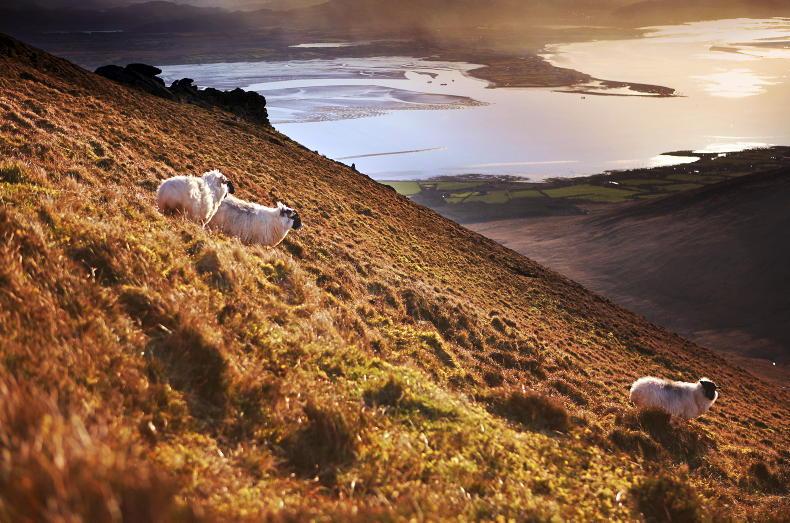
His vision going forward is for upland areas to be recognised as really important and contributing for food production but also delivering “for that very wide range of public goods that so many people are interested in, whether that is storing carbon, storing water, supporting invertebrate activity or bird or mammal life – these areas can deliver for all these things if we get our farming systems right”.
Universal challenges
A lot of challenges facing upland areas were highlighted as being universal, be that in the UK, Ireland or further afield. Figures presented for sheep numbers in the UK places ewe and lamb numbers for the June sheep census at approximately 30m head.
At its peak sheep numbers hit 45m head in the mid-90s, driven by policy incentives with levels now similar to those in the early 1900s.
“You could say maybe that peak was a bit of a blip, maybe it was totally caused by headage payments and policy instruments and there is some truth in that actually but again if you think about this slow decline in sheep numbers over a period when we are still seeing our global [human] population increase we are still seeing a demand and opportunities for red meat consumption and red meat exports – real economic opportunities and we are not responding to that I would say,” added Stocker.
Most of the decline in UK sheep numbers has been seen in the uplands, which he attributes to agri-environment schemes and also partly to land owners. “There are huge areas of lands being taken totally out of production either through afforestation or schemes focused on carbon capture and trying to get money for public goods,” he said.
The reduction in sheep numbers in some areas were described as a total breakdown in established farming systems.
Multifunctional areas
As touched on already, farming in upland areas is multifunctional. The UK Government have set targets to maintain food production at 65% for all foods and 77% for indigenous food production.
Stocker commented that there is opportunities to underpin food production in upland areas on the back of improved flock productivity while still leaving scope for the uplands to service other public good aims.
“It’s not as simple as are we working in an area of land sharing or land sparing.
“There is definitely a lot of land sharing going on in the uplands but there are also plenty of places in the uplands where we can land spare and we can put land over to rewetting on peat and really focusing on carbon storage and water storage as well.”
Upland areas often do not get full credit for the food they produce as vast quantities of store lambs are transferred to lowland areas for finishing while 40% of breeding ewe numbers are located in the uplands and act as a supply for breeding ewe numbers in lowland areas.
Farming in upland areas in the UK is occurring against a backdrop of numerous other targets, including climate targets and the route to net zero by 2050 and a nature target of 30% of lands in England being managed for nature by 2030.
Stocker explained that there are polarised views on whether this should be lands entirely designated for nature or whether it can include land that is delivering for nature through farming. There are also targets around water quality and air quality.
Wildfire risk
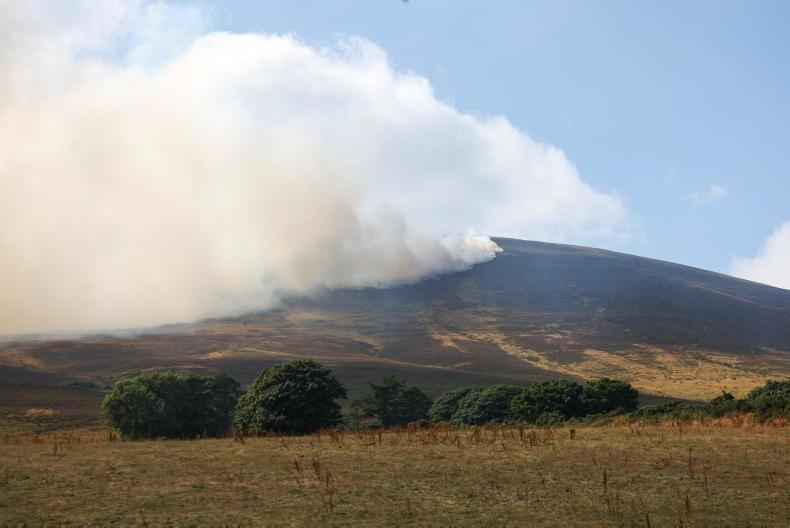
Large parts of the UK has experienced what Stocker describes as two years of fairly extreme droughts and two years of increased wildfires.
There are sobering figures including 28,299ha of lands burnt in 2026, 1,354 wildfires reported, 13,000 calls to emergency areas and 966 wildfires attended by emergency services.
“I think there is a direct correlation between the reduction in livestock numbers and the increase in fuel load vegetation in the uplands and the outbreak of these wildfires.
“They are climate related, there is no doubt about that but they are also land use related in terms of that absence of grazing, absence of vegetation management and the fact that wildfires have probably happened for a long time, but what is different now is that once they start it is difficult to control them probably because there are no natural vegetation breaks.”
These regularly happen during bird nesting season and do immense damage to nesting birds, invertebrate and to reptiles in addition to putting property at risk and coming at a big cost to society to control.
Economic activity
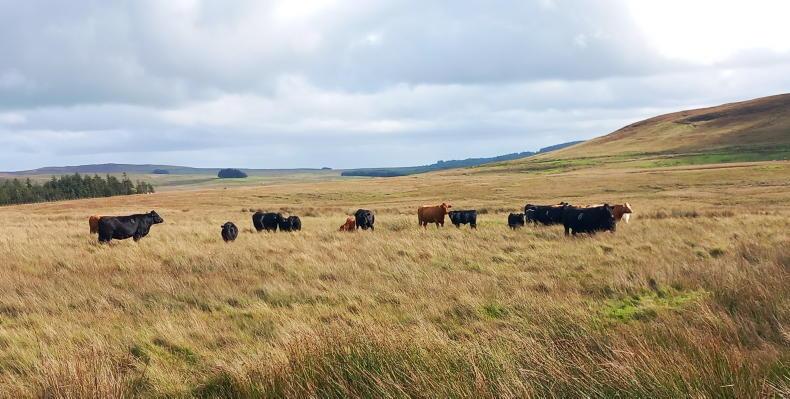
In addition to 40% of breeding sheep residing in the uplands they are also home to 27% of beef breeding cattle and 13% of the agricultural workforce who live there.
Stocker said that this plays a vital role in keeping infrastructure and services in place in these areas and providing a public good when tourists visit these areas and helping to keep the local economy going.
It is seen as vital to maintain economic activity in uplands areas to retain the next generation of farmers in upland areas and attract back those who may have left temporarily but longer term have ambitions to return.
Ridiculous situation
Some 70% of protected sites are in upland areas with 82% of common lands, akin to commonage or national parks, in upland areas. It is not surprising that these areas are the target for agri-environmental schemes but the make-up of these are highly flawed in Stocker’s opinion.
“You will know that in England we have lost the single payment and everything is being pushed in to agri-environment schemes. I think it is [a] ridiculous situation where our agri-environment schemes are largely funded through an income forgone basis where you have to demonstrate a loss to your income before you can be eligible for payments and it is not helping to create viable farming systems in the uplands and being rewarded for the environmental good that we are doing.”
The NSA have been trying to lead the conversation of highlighting the complementary role that sheep farming in the uplands can play with a number of reports published over the last two decades showing how sheep farming can deliver to the wider public good.
Numerous collaborations have been set in motion with the James Hutton Institute, SRUC, the Centre for Ecology and Hydrology and Aberystwyth University in aiming to demonstrate evidence of where grazing delivers really good outcomes for the uplands.
Farmers leading the narrative
Stocking maintained that farmers must lead the narrative on managing the uplands in what has become an increasingly crowded opinion space. Failing to do so risks farmers voices being drowned out by other voices such as non-government organisations who often do not see a role for sheep in upland management.
The potential consequences were borne out in a situation which developed on Dartmoor National Park, Devon, England. In 2022 a situation occurred between the farmers/grazers on Dartmoor and environmental NGOs and Natural England when letters were sent to farmers from Natural England saying that if they wanted to continue in their agri-environmental schemes they would have to reduce their stock numbers by at least 50%, and in some cases remove stock entirely.
There was understandably uproar which Stocker said led to a government review which in turn led to an enquiry in to governance and the way Dartmoor was managed. In 2023 David Fursdon, Lord-Lieutenant of Devon chaired and conducted a review that made 42 recommendations, of which the government adopted 25 in 2024 and established the Dartmoor Land Use Management Group (DLUMG).
Chaired by Stocker, the objectives of the DLUMG is to implement the 25 recommendations that the government accepted over a period of two years with a focus on improving the condition of protected sites, to create a multifunctional land use framework underpinned by reliable data.
Stock numbers
The large-scale 95,312ha national park was established in 1951 and ranges from 30m to 621m above sea level. Approximately 37% of the area is common lands divided in to 92 separate land units with 54 landowners and about 850 registered commoners.
There is a long history of grazing on Dartmoor. Stock numbers include 1,500 ponies across the summer and winter (was 20,000 head in 1950s), 3,500 cattle (2,000 in 1950) of which most move off in the winter and 38,000 sheep in summer and 31,000 in winter (13,000 in 1950s).
Sheep numbers in the 1950s were lower due to the fact that sheep were generally moved on to Dartmoor in the summer and removed in the winter. The advent of breeds of sheep which can withstand harsh conditions has witnessed sheep numbers increase and remaining year-round on the area. The DLUMG has a big focus on peatland restoration. Stocker acknowledges that there is still some areas receiving more grazing than is ideal for the vegetation, but there are vast areas, possibly rising to as much as 70% of the area which is undergrazed. This, he said is more an issue of livestock management and stock dispersal as much as it is livestock numbers.
Learnings from Dartmoor
Getting collaboration between a wide range of stakeholders, all with differing views on how the uplands should be managed, has been challenged. “We have made progress; there is no doubt about that. We have increased the level of understanding of different viewpoints and different approaches but getting true collaboration is not easy and I wouldn’t say we are there yet and have a long way to go,” Stocker said.
Some management and grazing principles have been discussed but a lack of understanding on certain aspects is creating challenges. Burning has never taken place on Dartmoor and this is a hugely contentious issue. Progress has been made on developing a land use framework and Stocker explained this has essentially stemmed from mapping the different areas such as peat areas, tree cover, hydrology, soil types, stocking levels etc.
This is being used to have on the ground discussions on where things can be improved such as getting Molinia under control, resting some protected sites which could do with a break from grazing and maybe increase tree cover all while working with local people. Other ways are being looked at on how site condition can be monitored accurately and engage farmers and land managers in this process rather than someone else coming in from a distance, doing it and then possibly tension regarding the results.
Rewards for dropping stock numbers is only reducing the viability of such systems so the goal is looking at what can be done to reward and incentivise farmers for managing their stock in a way that delivers really good environmental outcomes rather than their income solely being replaced by payments.
Management practices
“We have got some adaptive grazing trials going on. We are looking at the cost of different ways of managing livestock – that can be done through electric collars, it can be done through feeding and driving livestock in to certain areas or partly through mechanical control and then getting stock to disperse more across the common and try and understand the relationship more between a pony grazing, cattle grazing and sheep grazing”.
Strategic use of ponies and cattle to graze and clear away some of the Molinia grasses and improve vegetation is seen as having significant potential in encouraging sheep to disperse over a greater area but this is not an easy solution as you need cattle that are suitable to graze in such terrain.
A big challenge is the implications for livestock management. “If you reduce stock numbers on one common what happens is you create a vacuum and just breakdown that hefted system and attract other stock across so you break down what is quite an established system of grazing,” explained Stocker.
There is a big focus on winter removal of sheep which is not possible from the point of view of hefted systems and disease tolerance. “A major problem we have got coming through now is a disease called louping ill, a tick-borne virus. If sheep are exposed to it all the time they tend to develop a level of resistance or immunity but if you off-winter them that immunity will break down and you will get huge losses so we still have big challenges.”
Looking forward
Stocker said that there is a long road ahead in establishing frameworks on how best to manage upland areas with longterm plans needed that can deliver continual improvement. He stressed that farmers need to be at the centre of these developments. “We as a farming community need to take more ownership of these other issues that keep coming up and that we are being bashed for so the more that we can take an interest in and understand and be passionate about our peatlands and our water and our nature and our birds and all sorts, that is where we have got to get to.
“It baffles me that we have ended up with so many environmental NGOs and nature organisations that have owned that agenda and taken it away from us. We need to own those things more.”